What Does a Hand-Coded Website Actually Mean? (And Is It Better?)

You've probably seen web designers advertise "hand-coded websites" at some point. Maybe it sounded impressive. Maybe it sounded like a marketing phrase that didn't mean very much. Either way, you're probably wondering: does someone literally sit there and type every single line? And more importantly, does it actually make any difference to your business?
The honest answer to both questions is yes, but the detail matters. In this guide, we'll explain what hand-coded actually means in plain terms, how it compares to using a website builder, what the genuine advantages are, and whether it's the right choice for every business (spoiler: it isn't always).
What Is a Hand-Coded Website?
A hand-coded website is one where a developer writes the code directly, line by line, using the core languages that all websites are built on: HTML, CSS, and JavaScript. HTML creates the structure of the page: the headings, paragraphs, images, and buttons. CSS controls how everything looks: the colours, fonts, spacing, and layout. JavaScript handles any interactive elements, like dropdown menus or contact forms.
Every element on the page was put there intentionally. Every line of code exists because a developer decided it should. There are no extra bits generated in the background, no pre-written templates being adapted, and nothing the developer doesn't understand.
A useful way to think about it: it's a bit like having a suit tailored specifically for you, rather than buying one off the rack. An off-the-rack suit might fit well enough, and for many situations it's perfectly fine. But a tailored suit is built around your exact measurements, with choices made specifically for you. Nothing is there by default or because it happened to come with the pattern.
How Is It Different From Website Builders?
Platforms like Wix, Squarespace, and WordPress page builders work differently. Instead of writing code from scratch, they let you assemble a website by choosing a template and dragging and dropping components into place. You pick a layout, add your text and photos, and the platform generates the code for you in the background.
This approach has real advantages. It's fast. It's accessible to people with no technical knowledge. And for certain use cases, it produces a perfectly functional website without the need for a developer at all.
The trade-off is that the code these platforms generate is rarely as clean or efficient as code written by hand. Because the platform has to account for every possible layout and combination a user might choose, it includes a lot of code that your specific site doesn't actually need. Your website ends up carrying weight it isn't using.
This isn't inherently a problem. Website builders solve a genuine problem for a lot of businesses, and there's no reason to dismiss them outright. The question is whether the trade-offs matter for your specific situation, which we'll come to later.
Why Do Some Web Developers Choose to Hand-Code Websites?
For developers who hand-code, it's rarely just a philosophical preference. There are practical reasons behind the choice, and they tend to show up most clearly once a site has been live for a while.
Better Performance
When code is written specifically for your website, there's nothing unnecessary slowing it down. Pages load faster because they're not carrying code for features you don't use. Images are optimised deliberately. Scripts only load when they're needed.
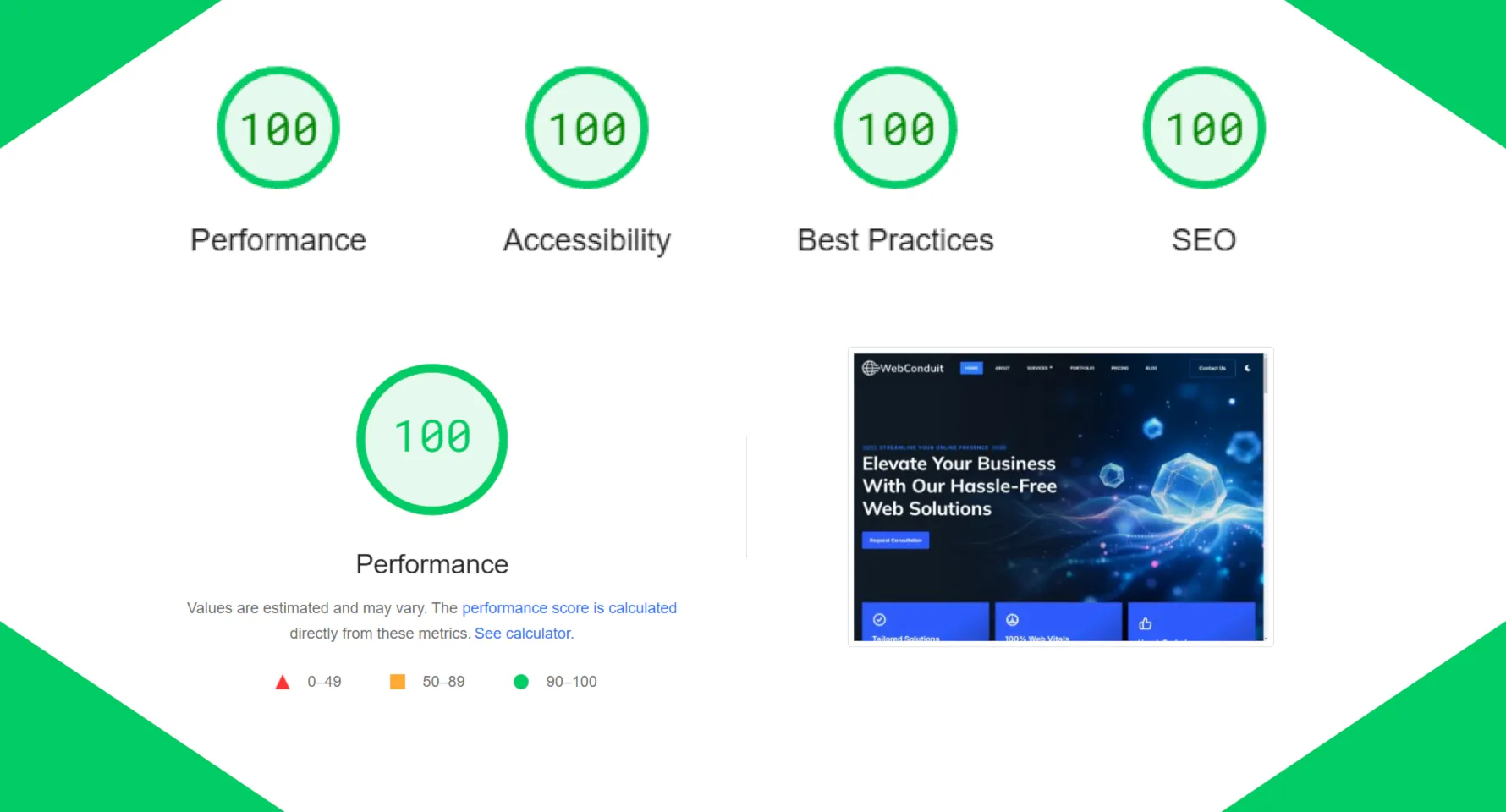
This matters more than most people realise. Google's own research shows that a significant proportion of mobile users will leave a page before it finishes loading if it takes too long. Performance also affects your search rankings directly, through metrics called Core Web Vitals that measure how quickly your pages load and respond. At WebConduit, we consistently achieve a 98+ Performance score on Google PageSpeed Insights precisely because we control every line of code on every site we build.
Greater Flexibility
When your site is built from scratch, it can look and work exactly the way your business needs it to. There's no fighting against a template that almost fits but not quite, no awkward workarounds, and no settling for a layout that was designed for a different kind of business.
Every section, every page, every interaction is designed around your specific goals. If you need something unusual, it can be built. If the standard approach doesn't suit your content, it can be changed. That flexibility is hard to replicate on a platform where your choices are limited by what the template allows.
Improved Security
Hand-coded sites tend to have a smaller attack surface than sites that rely heavily on plugins and third-party components. Every plugin you add to a WordPress site is another piece of software written by another developer that needs to be kept up to date and could potentially introduce a vulnerability. A hand-coded site with no plugins has far fewer of those entry points.
It's worth being clear: no website is completely immune to security issues, and hand-coding isn't a magic solution. But fewer dependencies means fewer things that can go wrong, and a developer who understands the codebase fully is better placed to respond quickly if something does.
Easier to Maintain Long-Term
Because a hand-coded site was built intentionally, a developer who understands it can make changes predictably. There's no risk of updating a plugin and accidentally breaking something else. There are no mysterious interactions between components that nobody fully understands. When something needs to change, you know exactly what you're touching and what the effect will be.
This might sound like a developer concern rather than a business owner concern, but it has real consequences. Sites that are difficult to maintain tend to get neglected. Updates get skipped, fixes take longer, and the site gradually drifts from what it should be. A maintainable codebase keeps the site in better shape for longer.
Are Hand-Coded Websites Better for SEO?
Not automatically! And anyone who tells you otherwise is oversimplifying.
SEO depends on a lot of factors: the quality of your content, the structure of your pages, your page titles and metadata, how you link between pages, how fast the site loads, and how accessible it is. A hand-coded site doesn't rank well just because it's hand-coded.
What hand-coding does is give you greater control over all of those things. You're not constrained by what a platform does with your page titles or how it handles your heading structure. You can make deliberate decisions about performance, accessibility, and structure that are harder to implement on a builder platform.
So the more accurate answer is: a hand-coded website creates better conditions for good SEO. Whether those conditions are fully taken advantage of depends on the developer building it and the decisions made along the way. Our on-page SEO tips guide covers the specific things that make the biggest difference, whether you're on a custom-built site or not.
Are There Any Downsides?
Yes, and it's worth being straightforward about them.
Hand-coded websites take longer to build than template-based ones. Because everything is created from scratch, there's more work involved before anything visual exists. That time costs money, which means hand-coded sites typically cost more upfront than a website built on a template or a drag-and-drop platform.
They also require a developer for any significant changes. Unlike a website builder where you can log in and move things around yourself, changing the layout or structure of a hand-coded site means going back to the developer. You can usually edit text and images yourself through a content management system, but structural changes need technical knowledge.
And for some types of website, hand-coding isn't the most practical approach at all. Large e-commerce stores, membership platforms, and sites that need complex user-generated content are often better served by established platforms built specifically for those use cases.
For a brochure website; the kind that explains what you do, who you serve, and how to get in touch; the trade-offs are often well worth it. The site loads faster, performs better, and tends to hold up well over time. But it's worth understanding what you're signing up for before you commit.
Who Is a Hand-Coded Website Best For?
A hand-coded website is often a great choice for:
- Local businesses and tradespeople who rely on search visibility
- Consultants and professional services firms where credibility matters
- Businesses that want their site to reflect a distinct brand identity
- Anyone prioritising long-term performance and low maintenance overhead
- Businesses where the website is a primary source of leads or enquiries
It may not be the best fit for:
- Large e-commerce stores with hundreds of products
- Membership platforms or sites requiring complex user accounts
- Sites that need lots of user-generated content or community features
- Anyone who needs a basic website live this week with minimal investment
Being honest about this distinction matters. We turn down projects that aren't well suited to what we do, because the right tool for the job produces better results than forcing the wrong one. If a website builder genuinely fits your needs, it's better to know that upfront than to invest in something that doesn't match your situation.
Common Myths About Hand-Coded Websites
A few misconceptions tend to come up whenever hand-coding is discussed.
"They're impossible to update."
This is one of the most common concerns, and it's usually based on an outdated picture of how hand-coded sites work. Most hand-coded websites today are built with a content management system that lets you update text, images, and blog posts yourself, without touching any code. Structural changes like adding a new page template or redesigning a section do require a developer. But day-to-day content updates are typically straightforward.
"They're old-fashioned."
Every website on the internet, regardless of how it was built, runs on HTML, CSS, and JavaScript. Website builders don't replace those languages: they just generate them automatically. Hand-coding isn't a retro approach to building websites — it's the same underlying technology, applied more deliberately.
"Only big companies need them."
Performance, reliability, and a site that reflects your brand accurately arguably matter more to a small business than a large one. A big company can absorb the consequences of a slow or poorly built website more easily. For a small business, the website is often the main way potential customers form a first impression. Getting it right matters.
"They're only about speed."
Speed is one benefit among several. Flexibility, security, maintainability, and the ability to build something that fits your business precisely are all part of the picture. Speed tends to get the most attention because it's easy to measure and directly affects rankings, but it's one piece of a larger argument for hand-coding rather than the whole of it.
Is a Hand-Coded Website Right for Your Business?
It depends on what you're trying to achieve.
If you need the cheapest possible website, or you need something live by the end of the week, a website builder is probably the more sensible choice. Those are legitimate priorities, and there's no point investing in something more substantial than your situation calls for.
If you're thinking about your website as a long-term investment — something that performs well, reflects your brand properly, holds up over time, and is built around your specific goals rather than a generic template — then a hand-coded website is worth serious consideration.
The businesses we work with at WebConduit tend to be ones where the website plays a meaningful role in how customers find them and decide to get in touch. For those businesses, the performance, flexibility, and reliability that come with hand-coding make a genuine difference. You can find out more about our approach on our Website Design and Development page, or take a look at our All-In-One Website Package if you'd prefer ongoing support, hosting, and maintenance included from the start.
Final Thoughts
Hand-coding isn't about being clever, avoiding modern tools, or doing things the hard way for the sake of it. It's about building a website that's tailored to your business rather than forcing your business to fit a template.
The best website for your business is the one that does what you need it to do, performs well enough that visitors don't leave before it loads, and holds up reliably over time. For a lot of small businesses, that's a hand-coded site. For some, it isn't. The important thing is making that decision based on what actually fits your situation, not based on what sounds most impressive in a sales pitch.
If you'd like to talk through whether a hand-coded website makes sense for what you're trying to achieve, get in touch. We're happy to give you a straight answer, even if that answer is that a simpler solution would serve you better.
Contact Us