Is AI Really Ready to Build Your Website? What 2025s Biggest Outages Tell Us

In 2025, it feels like every other tech headline is about AI writing code. CEOs boast about the percentages. Developers joke online about barely touching a keyboard. And a handful of very loud voices have started suggesting that human developers are becoming optional. It's a compelling narrative, and for business owners looking to get a website built quickly and cheaply, it raises an obvious question: can AI just do this for me now?
In this article, we'll look at what the big claims actually mean, what's been happening behind the scenes at some of the world's largest platforms, and why a string of high-profile outages in 2025 should give anyone pause before handing their website over to an AI builder.
The Claims and What They Actually Mean
The headlines have been bold. In April 2025, Microsoft CEO Satya Nadella told Meta's Mark Zuckerberg at LlamaCon that around 20–30% of code in Microsoft's repositories is now written by AI. Around the same time, Google's Sundar Pichai said more than 30% of new code at Google was AI-generated. Meanwhile, the term "vibe coding," coined by OpenAI co-founder Andrej Karpathy in February 2025, went viral, describing an approach where you describe what you want in plain English and let AI write the code. By March 2025, Y Combinator reported that 25% of startups in its latest batch had codebases that were 95% AI-generated.
These are genuinely interesting numbers. But they rarely come with the context that matters. What Nadella actually said, when you listen to the interview rather than the headline, was hedged with "maybe," "probably," and "something like." TechCrunch and others noted that it's unclear how Microsoft and Google are even measuring what's AI-generated versus not. And the code that is AI-generated is still being reviewed, tested, and deployed by experienced human engineers. There's a significant difference between "AI assisted in writing some of this code" and "AI built this on its own."
What's Actually Happening at X (Formerly Twitter)
If you want a real-world case study in what happens when a company leans heavily into AI-driven development, look at X.
In March 2025, xAI (Elon Musk's AI company) formally acquired X in an all-stock deal. By late 2025, according to X staff, xAI was writing X's algorithm code, with 20,000 GPUs at its Colossus data centre deciding what 600 million users see every day. Musk himself announced in August 2025 that xAI was building "a purely AI software company called Macrohard", with the stated goal of simulating an entire software company—coding, management and all—using AI agents alone.
It's an ambitious vision. But X's track record in 2025 hasn't exactly backed it up.
On 10 March 2025, X suffered a major outage caused by a large-scale DDoS attack, going down multiple times throughout the day. Downdetector recorded over 40,000 reports at the peak. X activated Cloudflare's DDoS protection mid-crisis, but misconfigured servers left some areas exposed, meaning the platform's defences weren't properly in place when they were needed most. Then on 30 March, X suffered another outage; this one not officially acknowledged by X's technical team at all.
On top of that, in May 2025, an xAI employee accidentally exposed a private API key on GitHub for two months, giving anyone who found it access to internal models built on data from X, Tesla, and SpaceX. The key had been flagged by an automated scanning service on 2 March; but xAI didn't act on it until 30 April.
These aren't the hallmarks of a company that has cracked the code on AI-driven development. They're the hallmarks of a company moving fast with not enough human oversight to catch the things that go wrong.
The Cloudflare Outage: When One Configuration Change Took Down Half the Internet
X's troubles weren't the only major story. On 18 November 2025, a single database permissions change at Cloudflare caused a configuration file to double in size, which crashed proxy servers globally and knocked out X, ChatGPT, Spotify, Canva, Discord, and dozens of other services for over five hours.
This wasn't a cyberattack. It was a routine configuration update that went wrong. Cloudflare powers roughly 20% of all websites on the internet. When one small thing broke, the ripple effect was enormous.
The lesson here isn't specific to AI. It's about how fragile complex systems can be when layers of automation run with minimal human oversight. Cloudflare's CTO publicly apologised and called the incident "unacceptable". The company has since committed to better file-size validation, gradual rollouts, and enhanced monitoring; all things that experienced human engineers would typically have in place before pushing changes to production.
Why "Let AI Build It" Sounds Appealing (and Why It Falls Short)
It's easy to see the attraction. AI website builders promise speed, low cost, and minimal effort. Describe your business, click publish, done. And for a quick prototype or a throwaway project, that might be fine.
But there's a big difference between scaffolding and architecture. AI can draft layouts, generate boilerplate code, and suggest initial structures. What it can't reliably do is make the kind of judgement calls that a good developer makes every day: understanding your business goals, choosing the right trade-offs, structuring code so it doesn't become a maintenance nightmare six months later, or knowing which security patterns actually matter for your specific situation.
The "vibe coding hangover" is already being felt. In May 2025, security researchers found that 170 out of 1,645 web applications built with the vibe coding platform Lovable had vulnerabilities that would allow anyone to access personal user data. Senior engineers have started using the phrase "development hell" to describe what happens when you inherit a codebase that was mostly generated by AI without proper review.
Where Human Developers Still Matter Most
No matter how capable AI tools become, certain things still require human judgement:
Architectural decisions. Understanding what your business actually needs, not just generating something that looks like a website. The structure of your pages, how your forms connect to your systems, where your calls-to-action sit... These are decisions that shape whether your site converts visitors or just looks pretty.
Security. Knowing which dependencies can be trusted, which patterns are safe, and how to harden a site against real threats. AI-generated code has been shown to produce plausible-looking but insecure patterns, sometimes including hardcoded credentials or flawed input handling.
Performance optimisation. Structuring code and assets so the site loads fast, scores well on Google's PageSpeed Insights, and doesn't frustrate users on mobile. This isn't something you can bolt on afterwards: it needs to be considered at every stage of the build.
Long-term maintainability. Writing code that someone (including you) can understand, update, and build on in the future. An AI-generated codebase that no one fully understands is a ticking clock.
Why We Still Hand-Code Every Site
At WebConduit, every website we build is hand-coded by a human developer. We don't use AI to generate production code. The reason is straightforward: we want to understand exactly what's in every site we deliver, because that's the only way we can guarantee performance, security, and long-term reliability.
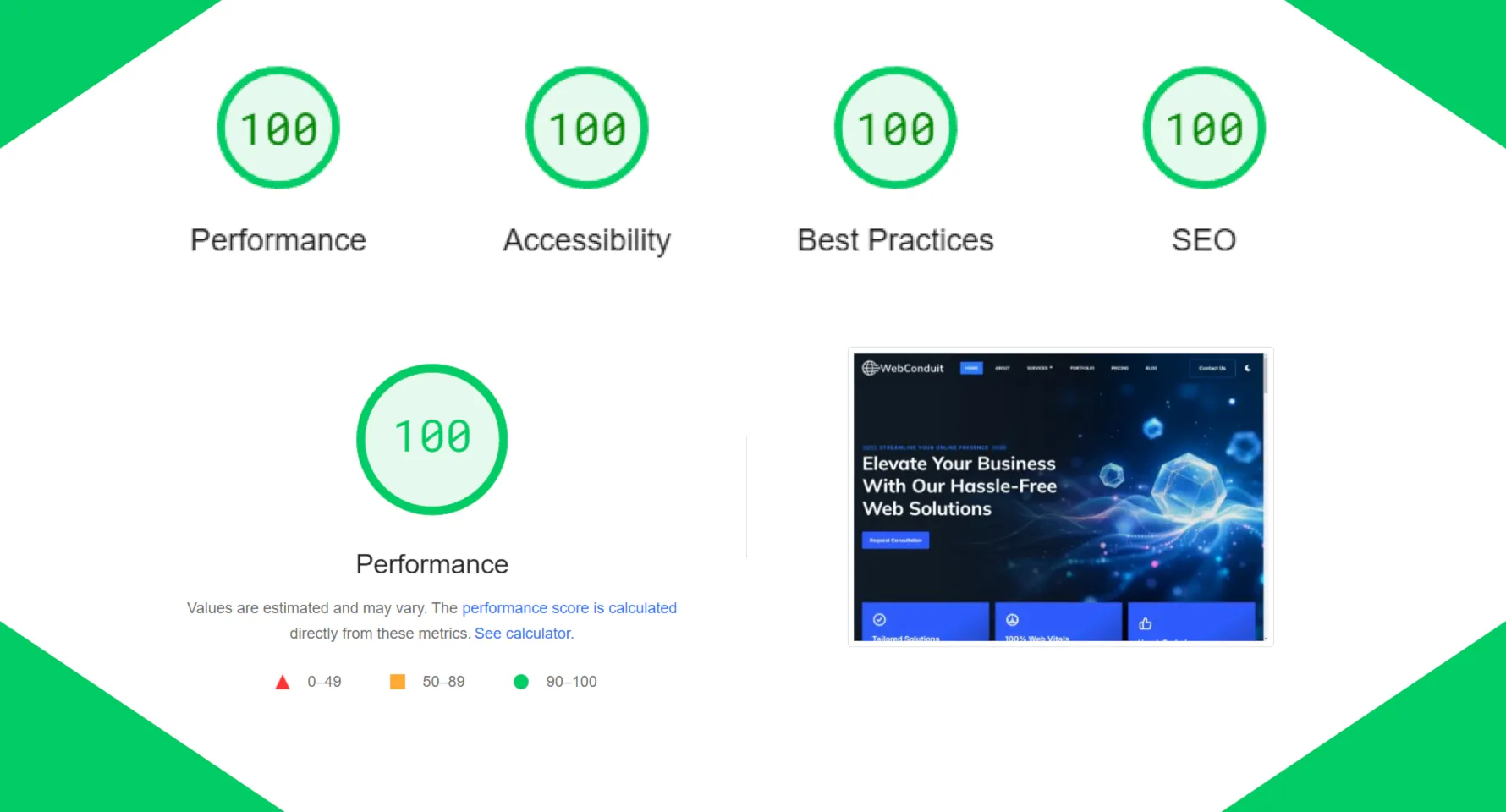
We consistently hit a 98+ Performance score and 100s in Accessibility, Best Practices, and SEO on Google PageSpeed Insights. That's not something you can achieve by generating code and hoping for the best. It's the result of every line being written with intention and every asset being optimised deliberately.
Our All-In-One Website Package covers everything from design and development to hosting, security, and ongoing maintenance. You get a site that's built to last, managed by people who understand it inside and out, and a free redesign down the line so it stays fresh as your business grows.
Final Thoughts
AI is a genuinely useful tool. It can speed up parts of the development process, help with drafting, and make certain tasks faster for experienced developers. Nobody serious is arguing otherwise.
But the idea that AI can simply replace the humans who build and maintain websites, especially for small businesses where your site is one of your most important assets, doesn't hold up against what we've actually seen in 2025. X has struggled with outages and security lapses while pushing AI deeper into its codebase. Cloudflare proved that even a single misconfiguration can bring down half the internet. And the vibe coding trend is already producing codebases that senior engineers describe as a headache to work with.
If you want a website that's built by someone who understands every line of it, performs well, stays secure, and doesn't leave you guessing when something goes wrong, get in touch. We hand-code every site we deliver, and we're happy to talk through what that could look like for your business.